
My honest take: the wrong question is whether AI replaces developers. The useful question is what AI changes about developer throughput, attention, and ownership.
TLDR
- AI increases throughput. It does not turn one developer into three independent developers.
- Human attention is still finite, so parallel work still has a ceiling.
- AI helps prototypes and demos move faster, but production readiness still needs review and ownership.
- The best framing is protective, not threatening: AI gives developers leverage so they stay effective.
- Teams should measure faster learning and better output, not raw token output or code volume.
Throughput, not replacement
AI does not magically create three developers out of one. What it does is increase the throughput of a single developer.
That distinction matters. Replacement implies that the tool removes the need for the person. Augmentation means the person stays in the loop, but can move faster and get more done with the same time.
My default rule is simple: AI changes the unit economics of development, not the need for engineering judgment.
Code gets cheaper to produce. Review, sequencing, clarification, and ownership do not.
Attention is the real bottleneck
The strongest argument is not about code generation speed. It is about human attention.
A developer can supervise more work when AI reduces the amount of attention needed per ticket. That is real. But the ceiling still exists. At some point, the supervision load gets too high and the quality drops.
That is why the juggling metaphor works. One task is manageable. Two can work. Add enough parallel work and the balls start dropping.
AI can compress the time from idea to implementation. It can shorten the period of attention required for a ticket. It cannot remove the need to inspect, validate, and own the result.
Why demos move faster than production
This is where AI is already useful in a concrete way.
A proof of concept that used to take two weeks can sometimes produce a demo in three days. That is a real gain. It gives teams more room to test ideas, show progress, and explore options before committing to a direction.
But a demo is not production.
AI output still needs to be shaped into code the team actually wants to ship. The point is blunt about that: the code has to be the code you need, not just code that exists.
That is the difference between:
- something that looks impressive,
- something that works in a demo,
- and something that is production-grade.
Those are not the same thing, and pretending they are is how teams get burned.
Why the replacement framing backfires
The replacement framing sounds dramatic, but it is still the wrong way to think about the tool as a developer.
If you treat AI like a threat, you get fear and resistance. If you treat it like something you have to learn to control, you get leverage.
The real question is whether you are using it well enough to stay effective and in control.
That is the more honest line.
AI can help a developer do more. It does not remove the need for:
- judgment,
- sequencing,
- review,
- context management,
- or accountability.
You are still responsible for the code, even if the machine drafted it.
What changes for teams
If AI is an augmentation tool, teams should adjust their expectations accordingly.
Do not measure success by how much code the model spits out. Measure whether the team reaches good decisions faster and ships better work with less wasted effort.
Do not ask whether the model can write code. It can.
Ask whether the developer can:
- specify the work clearly,
- steer the model when it drifts,
- reject bad output quickly,
- and keep the result aligned with production standards.
That is the actual skill shift. The developer becomes more of a supervisor, reviewer, and owner: a Coding Agent Operator. The tool handles more of the mechanical drafting. The human handles the judgment.
Guidance matters
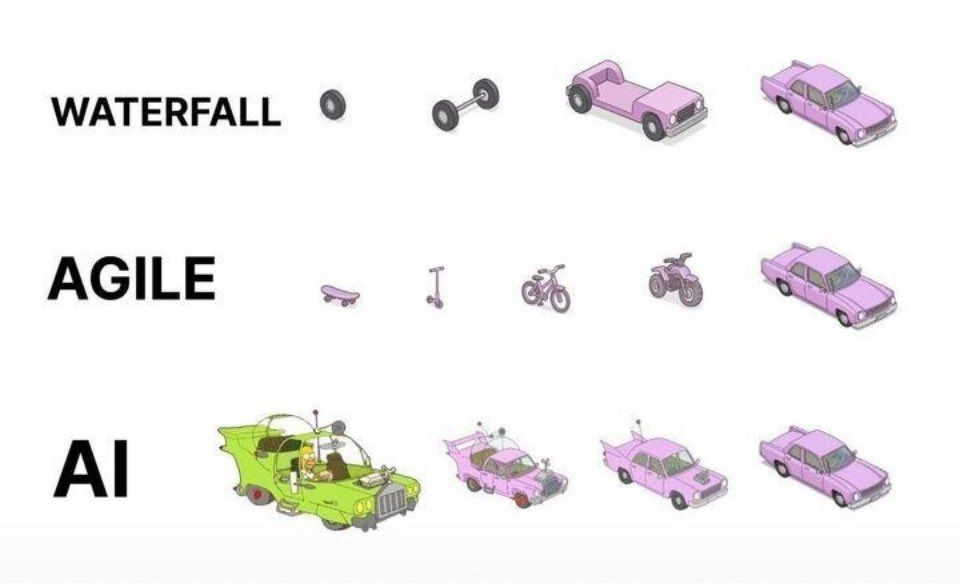
AI without guidance can hand you a half-working spaceship. Your job then becomes dismantling it piece by piece until you finally get back to the car you actually wanted.
With project guidance in place, the machine should build the car in increments and keep the output useful and accurate enough for the current step.
That is why the work you put into AGENTS.md and the project skills matters.
It keeps the model aligned with the project instead of letting it invent its
own shape of the solution.

Image credit: ProgrammerHumor. Original image: https://i.programmerhumor.io/2025/06/78039b3549427e200d78c840cba271d067b8c80126f216df1a1dcf66c976369d.png. Used here as a supporting reference for the “spaceship versus car” framing.
Final rule
AI is not replacing developers by making code magically correct.
It is augmenting developers by making code cheaper to produce, which makes human judgment, attention, and accountability more important, not less.


Comments