
If you are building with AI, the question is often not "prompt or skill?" but "what do I need the output to do next?" That is usually the real decision point.
TLDR
Use this quick flow to decide whether a prompt, a skill, or both make the most sense.
flowchart TD
    Start[Do you need a specific text output\nthat you can use right away?]
    Start -- Yes --> Prompt["Use a prompt\nBest for one-off text output"]
    Start -- No --> Process{"Do you need a repeatable workflow\nwith tools in a fixed sequence?"}
    Process -- Yes --> Skill["Use a skill\nBest for repeatable processes"]
    Process -- No --> Both["Use both\nPrompt starts the task\nSkill handles the workflow"]

    Prompt --> PromptNotes["Summarization\nRewrites\nClassifications\nDraft replies"]
    Skill --> SkillNotes["Tool orchestration\nConsistent inputs and outputs\nReusable agent guidance"]
    Both --> BothNotes["Pipeline execution\nPrompts can invoke skills\nPrompts and skills are complementary"]
When to use prompts
Prompts are the right tool when the main thing you need is text.
That usually means the model can answer directly and the result can be used as soon as it is generated. You ask for a summary, a rewrite, a classification, a draft email, or a short explanation, and then you use the answer immediately.
Prompts work best when:
- You want one-off text output.
- The result does not need a deterministic multi-step workflow.
- Human review happens after the model responds.
- The task is mainly about language, not orchestration.
For example, a prompt that summarizes a long meeting note is easy to reuse and easy to evaluate. If the summary is good, you are done.
When to use skills
Skills are better when the work is a process, not just a response.
That means the task has a clear sequence, the tools matter, and you want the same behavior every time. The skill becomes a packaged workflow that tells the agent what to do, in what order, and with what inputs and outputs.
Skills work best when:
- The task needs multiple steps.
- Tool usage must happen in a specific order.
- The inputs and outputs need to stay consistent.
- You want something repeatable across sessions and users.
For example, if a task needs to read files, extract fields, transform data, and write a report in a specific format, a skill is a better fit than a standalone prompt.
Chat surfaces vs coding agents
From my perspective, in chat surfaces the preference is prompts.
That is because most chat products are optimized for conversational input and single-turn or lightly guided output. You can still use structured instructions, but a plain prompt is often the simplest and most portable choice.
In coding agents, my preference is skills.
Coding agents are a better fit for repeatable workflows because they can pair instructions with tools, scripts, and repository-local references. That makes skills much more useful when the agent has to do something beyond writing text. Skills are also well suited for repeatability and for discoverability by the agent itself, so they tend to fit coding-agent workflows better than plain chat prompts.
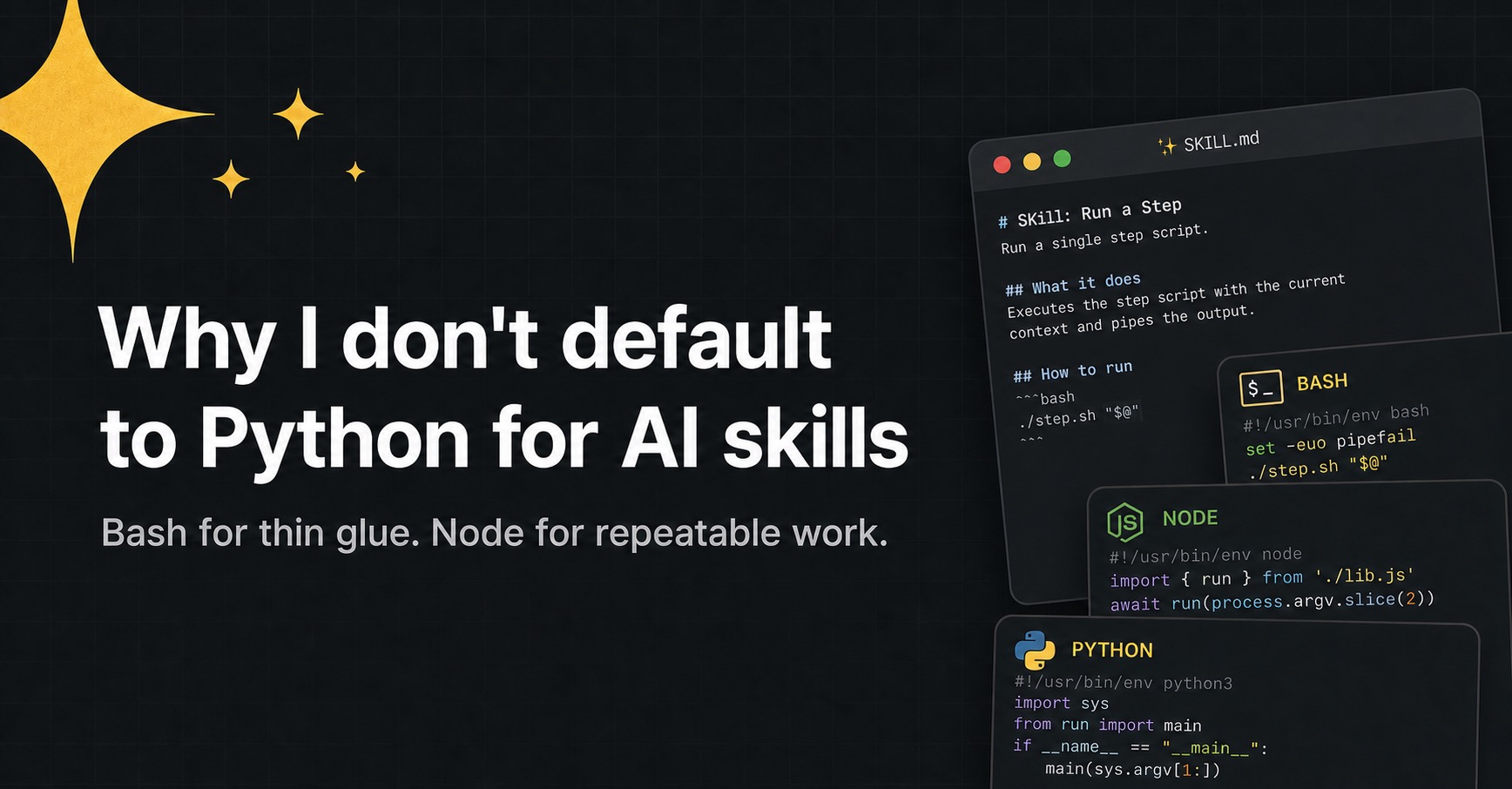
If you are designing a skill for a coding agent, make the description
explicit. Include the keywords, phrases, or task patterns that should trigger
the skill automatically even when the user does not invoke it directly. In
Codex, for example, that can be reinforced with a $skill-name style
reference.
You should not create a skill for one-off tasks, such as generating a very specific piece of code that you are unlikely to reuse. In that case, prompting your way toward the solution is usually the better compromise.
There is one important caveat: not every provider exposes Skills in the same
way. Claude is the only provider I have seen supporting Skills in chat
surfaces when code execution is enabled, and it can automatically pick
relevant Skills based on the request. That is still different from a project
SKILLS.md file in this repository, which is a local instruction file for
coding agents.
They can work together
Prompts and skills are complements, not competitors.
A skill can call out to prompts for parts of the workflow that are purely textual. In practice, that means the skill handles the orchestration and the prompt handles a narrow language task inside that process.
That pattern is useful when you want:
- A reusable workflow.
- A clear division between orchestration and generation.
- Prompts that can be shared, versioned, and reused inside multiple skills.
I like keeping reusable prompts in a skill's references/ folder so the whole
package stays self-contained. That makes the skill easier to move, review, and
maintain.
Another example is a coding agent running inside a pipeline. My personal approach is to still provide a prompt that defines what the agent should do, then let that prompt invoke skills that the agent already has access to in the pipeline. The prompt starts the work, and the skills handle the repeatable parts of the process.
A simple rule
My default rule is:
- Use prompts for text output that can be consumed immediately.
- Use skills for repeatable workflows that need tools and sequencing.
- Combine both when the workflow has a deterministic structure but still needs a model to write some of the output.
Conclusion
If you only remember one thing, make it this: prompts are for getting an answer, skills are for getting a process.
When the task is mostly language, start with a prompt. When the task is a repeatable workflow, move to a skill. If you need both, use both.
Resources
- Agent Skills
- OpenAI Codex Skills
- agents.md as a reference only

Comments